

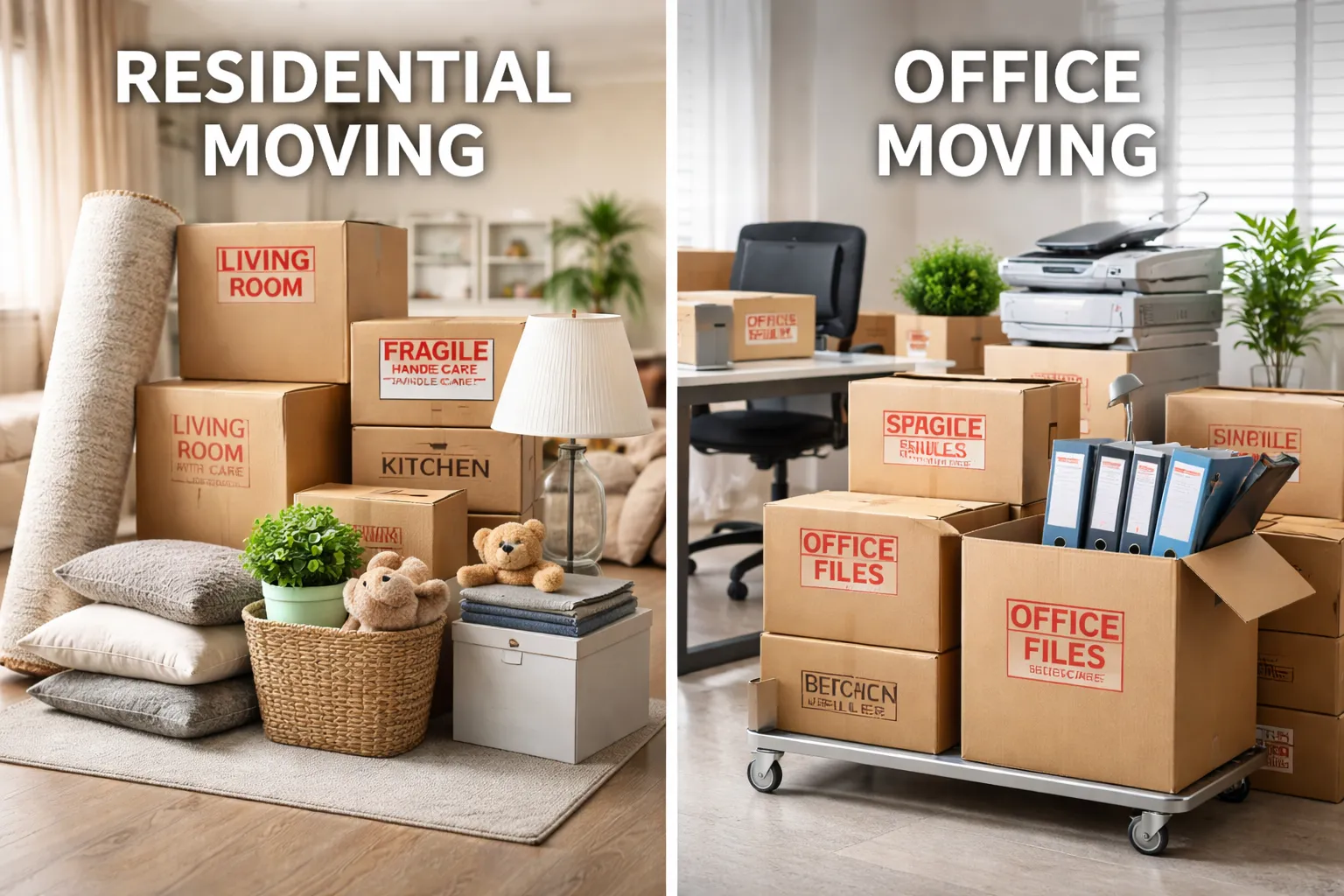
Difference Between Residential and Office Moving Services: Guide
Learn the key difference between residential and office moving services, including packing methods, equipment handling, planning, and relocation timelines.
The moving of one place to another has to be planned, structured and appropriately supported in terms of professional assistance. Nevertheless, there is a huge disparity between residential moving and office relocation services. Although it is the same packing, transportation and setting up, the intention, order, and implementation of both home and business relocation differ significantly.
The knowledge of residential and office moving assists an individual and company to make informed decisions. The home relocation services are unique in the sense that they aim at addressing the personal properties and the comfort of the family, whereas commercial relocation services emphasize the efficiency, time management and continuity in operations. When the right service is selected it guarantees a successful and a smoother move.
What Are Residential Moving Services?
Residential moving services target individuals and families that are moving out of their present house to their new home. These services involve packing of household goods, tearing down furniture, transporting of household goods and fitting them in the new home. Household shifting services can consist of sensitive products, appliances, personal property, and decorations.
Professional movers dealing with house to house relocations are aware of the emotional and economic worth of the household items. Home furniture moving services should be carefully packed and labeled and handled to avoid scratches, or even breaking. The main aim is to ensure that the relocation process into a new home is stress free and well organized.
What Are Office Moving Services?
Businesses that have to move their place of work are organized into office moving services. This involves relocation of office furniture, confidential documents, work stations and IT equipment relocation. Business relocation services should observe rigid schedules so that there is less interference with the normal operations.
A moving company that is based on a corporation is concerned with the coordination, precision, and speed. Office relocation might need after-hours or weekend working unlike residential moves. Moving services offered by commercial companies focus on the organization of the packing process, safe transportation of delicate equipment, and fast delivery to the new office.
Planning and Coordination Differences.
There is a great difference between residential and office relocation in terms of the level of planning. A residential change of residence normally centers on family time and individual convenience. Planning is not as essential, but there tends to be a higher degree of flexibility in schedules and de-packing.
The office moving services require thorough project management. Department coordination, inventory tracking and layout planning are among the commercial relocation requirements. Professional movers usually develop systematic relocation plans so that the downtime could be reduced to a minimum and the transition takes place.
Packing and Handling Requirements
There is a difference between home and office move packing an unpacking in jeddah. Residential moving services are characterized by packing delicate kitchenware, furnishings, clothing, and appliances. Movers provide protective wrapping, bubble cushioning and durable boxes which protect personal items.
On the contrary, office relocation necessitates safe electronic, file, and networking system packing. Anti-static material, labelled cables, and cautious disconnection are required during equipment relocation of IT equipment. Moving services in business use a systematic approach in packing to avoid confusion on re-installation.
Time Sensitivity and Business Impact
One of the differences that are critical in residential moving and office moving is time sensitivity. Home relocation services can make families unpack slowly after arrival. Little delays do not cause any financial losses.
Downtime has a direct effect on productivity and revenue to the business. Office moving services are meant to reduce business interruption. Professional movers organize strict timelines so that operations should not take too much time to ensure that they are resolved as soon as possible.
Cost and Resource Allocation
The residential moving services are mostly charged according to volume, distance and packing requirements. Household shifting services usually involve fewer crews and standard transportation equipment, thus cost estimation is not that difficult.
Moving services which are commercial in nature can be expensive because of complexity and urgency. The relocation of business frequently involves specific equipment, more workers, and organization. The extra resources to have safe and efficient office relocation is mirrored in the pricing.
Workforce and Equipment Differences
The common moving equipment needed in residential relocations includes dollies, packing materials, and midsize moving trucks. The packers and movers dealing with houses are concerned about the proper packing and proper placement in the new house.
Relocation of the office requires sophisticated machinery and well trained personnel. A corporate moving company can employ lifting systems, cable management system, and elaborate labeling system. Commercial moving services can be characterized by the work with large office furniture and technical equipment of a sensitive character.
Key Differences Between Residential and Office Moving Services
Here is a clear comparison to better understand residential vs office relocation:
- Residential moving focuses on personal household items, while office moving handles business assets and equipment.
- Home relocation services prioritize comfort and personal care; commercial moving services prioritize productivity and deadlines.
- Residential packing involves fragile household goods; office packing includes IT equipment relocation and confidential documents.
- Business relocation requires strict scheduling to reduce downtime; home moves offer more flexibility.
- Corporate moving companies often operate outside regular hours; residential moves follow family schedules.
- Office relocation requires structured planning and floor layouts; residential moves focus on room-to-room placement.
This comparison highlights the operational and structural differences between the two services.
Complexity and Risk Factors
Residential relocation implies emotional attachment and easily destroyed properties, whereas office relocation is more dangerous in terms of operations. Damage of IT equipment, lost files, or sluggish installation can affect the business continuity and profitability.
The residential and commercial movers as explained in simple terms are only differentiated in terms of scale and responsibility. Whereas the two also need professionalism, the office moving services need high-level technical skills, coordination, and the strategies of risk management.
FAQs : Residential and Office Moving Services
Final Thoughts
The residential and office moving services are different in terms of their goals, operation, and complexity. The services of home relocation are oriented to helping the families have an easy and systematic transition. Moving services of a business are focused on minimizing the downtimes and securing business assets.
The residential and office moving services are selected depending on your relocation requirements. Whatever be your needs whether you need household shifting services or a corporate moving company; awareness of such differences will help in planning and execution of the same. Professional movers also make all forms of relocation effortless, effective, and dependable.